 Add to Chrome
 Add to Firefox
 Add to Edge
LoKA: Low-precision Kernel Applications for Recommendation Models At Scale
May 11, 2026
Recent GPU generations deliver significantly higher FLOPs using lower-precision arithmetic, such as FP8. While successfully applied to large language models (LLMs), its adoption in large recommendation models (LRMs) has been limited. This is because LRMs are numerically sensitive, dominated by small matrix multiplications (GEMMs) followed by normalization, and trained in communication-intensive environments. Applying FP8 directly to LRMs often degrades model quality and prolongs training time. These challenges are inherent to LRM workloads and cannot be resolved merely by introducing better FP8 kernels. Instead, a system-model co-design approach is needed to successfully integrate FP8. We present LoKA (Low-precision Kernel Applications), a framework that makes FP8 practical for LRMs through three principles: profile under realistic distributions to know where low precision is safe, co-design model components with hardware to expand where it is safe, and orchestrate across kernel libraries to maximize the gains. Concretely, LoKA Probe is a statistically grounded, online benchmarking method that learns activation and weight statistics, and quantifies per-layer errors. This process pinpoints safe and unsafe, fast and slow sites for FP8 adoption. LoKA Mods is a set of reusable model adaptations that improve both numerical stability and execution efficiency with FP8. LoKA Dispatch is a runtime that leverages the statistical insights from LoKA Probe to select the fastest FP8 kernel that satisfies the accuracy requirements.

Learning Evidence Highlighting for Frozen LLMs
Apr 24, 2026Large Language Models (LLMs) can reason well, yet often miss decisive evidence when it is buried in long, noisy contexts. We introduce HiLight, an Evidence Emphasis framework that decouples evidence selection from reasoning for frozen LLM solvers. HiLight avoids compressing or rewriting the input, which can discard or distort evidence, by training a lightweight Emphasis Actor to insert minimal highlight tags around pivotal spans in the unaltered context. A frozen Solver then performs downstream reasoning on the emphasized input. We cast highlighting as a weakly supervised decision-making problem and optimize the Actor with reinforcement learning using only the Solver's task reward, requiring no evidence labels and no access to or modification of the Solver. Across sequential recommendation and long-context question answering, HiLight consistently improves performance over strong prompt-based and automated prompt-optimization baselines. The learned emphasis policy transfers zero-shot to both smaller and larger unseen Solver families, including an API-based Solver, suggesting that the Actor captures genuine, reusable evidence structure rather than overfitting to a single backbone.
SOLARIS: Speculative Offloading of Latent-bAsed Representation for Inference Scaling
Apr 13, 2026Recent advances in recommendation scaling laws have led to foundation models of unprecedented complexity. While these models offer superior performance, their computational demands make real-time serving impractical, often forcing practitioners to rely on knowledge distillation-compromising serving quality for efficiency. To address this challenge, we present SOLARIS (Speculative Offloading of Latent-bAsed Representation for Inference Scaling), a novel framework inspired by speculative decoding. SOLARIS proactively precomputes user-item interaction embeddings by predicting which user-item pairs are likely to appear in future requests, and asynchronously generating their foundation model representations ahead of time. This approach decouples the costly foundation model inference from the latency-critical serving path, enabling real-time knowledge transfer from models previously considered too expensive for online use. Deployed across Meta's advertising system serving billions of daily requests, SOLARIS achieves 0.67% revenue-driving top-line metrics gain, demonstrating its effectiveness at scale.
Evolving Embodied Intelligence: Graph Neural Network--Driven Co-Design of Morphology and Control in Soft Robotics
Mar 20, 2026The intelligent behavior of robots does not emerge solely from control systems, but from the tight coupling between body and brain, a principle known as embodied intelligence. Designing soft robots that leverage this interaction remains a significant challenge, particularly when morphology and control require simultaneous optimization. A significant obstacle in this co-design process is that morphological evolution can disrupt learned control strategies, making it difficult to reuse or adapt existing knowledge. We address this by develop a Graph Neural Network-based approach for the co-design of morphology and controller. Each robot is represented as a graph, with a graph attention network (GAT) encoding node features and a pooled representation passed through a multilayer perceptron (MLP) head to produce actuator commands or value estimates. During evolution, inheritance follows a topology-consistent mapping: shared GAT layers are reused, MLP hidden layers are transferred intact, matched actuator outputs are copied, and unmatched ones are randomly initialized and fine-tuned. This morphology-aware policy class lets the controller adapt when the body mutates. On the benchmark, our GAT-based approach achieves higher final fitness and stronger adaptability to morphological variations compared to traditional MLP-only co-design methods. These results indicate that graph-structured policies provide a more effective interface between evolving morphologies and control for embodied intelligence.
Generative Reasoning Re-ranker
Feb 08, 2026Recent studies increasingly explore Large Language Models (LLMs) as a new paradigm for recommendation systems due to their scalability and world knowledge. However, existing work has three key limitations: (1) most efforts focus on retrieval and ranking, while the reranking phase, critical for refining final recommendations, is largely overlooked; (2) LLMs are typically used in zero-shot or supervised fine-tuning settings, leaving their reasoning abilities, especially those enhanced through reinforcement learning (RL) and high-quality reasoning data, underexploited; (3) items are commonly represented by non-semantic IDs, creating major scalability challenges in industrial systems with billions of identifiers. To address these gaps, we propose the Generative Reasoning Reranker (GR2), an end-to-end framework with a three-stage training pipeline tailored for reranking. First, a pretrained LLM is mid-trained on semantic IDs encoded from non-semantic IDs via a tokenizer achieving $\ge$99% uniqueness. Next, a stronger larger-scale LLM generates high-quality reasoning traces through carefully designed prompting and rejection sampling, which are used for supervised fine-tuning to impart foundational reasoning skills. Finally, we apply Decoupled Clip and Dynamic sAmpling Policy Optimization (DAPO), enabling scalable RL supervision with verifiable rewards designed specifically for reranking. Experiments on two real-world datasets demonstrate GR2's effectiveness: it surpasses the state-of-the-art OneRec-Think by 2.4% in Recall@5 and 1.3% in NDCG@5. Ablations confirm that advanced reasoning traces yield substantial gains across metrics. We further find that RL reward design is crucial in reranking: LLMs tend to exploit reward hacking by preserving item order, motivating conditional verifiable rewards to mitigate this behavior and optimize reranking performance.
Meta Lattice: Model Space Redesign for Cost-Effective Industry-Scale Ads Recommendations
Dec 15, 2025The rapidly evolving landscape of products, surfaces, policies, and regulations poses significant challenges for deploying state-of-the-art recommendation models at industry scale, primarily due to data fragmentation across domains and escalating infrastructure costs that hinder sustained quality improvements. To address this challenge, we propose Lattice, a recommendation framework centered around model space redesign that extends Multi-Domain, Multi-Objective (MDMO) learning beyond models and learning objectives. Lattice addresses these challenges through a comprehensive model space redesign that combines cross-domain knowledge sharing, data consolidation, model unification, distillation, and system optimizations to achieve significant improvements in both quality and cost-efficiency. Our deployment of Lattice at Meta has resulted in 10% revenue-driving top-line metrics gain, 11.5% user satisfaction improvement, 6% boost in conversion rate, with 20% capacity saving.
Enhancing Embedding Representation Stability in Recommendation Systems with Semantic ID
Apr 02, 2025The exponential growth of online content has posed significant challenges to ID-based models in industrial recommendation systems, ranging from extremely high cardinality and dynamically growing ID space, to highly skewed engagement distributions, to prediction instability as a result of natural id life cycles (e.g, the birth of new IDs and retirement of old IDs). To address these issues, many systems rely on random hashing to handle the id space and control the corresponding model parameters (i.e embedding table). However, this approach introduces data pollution from multiple ids sharing the same embedding, leading to degraded model performance and embedding representation instability. This paper examines these challenges and introduces Semantic ID prefix ngram, a novel token parameterization technique that significantly improves the performance of the original Semantic ID. Semantic ID prefix ngram creates semantically meaningful collisions by hierarchically clustering items based on their content embeddings, as opposed to random assignments. Through extensive experimentation, we demonstrate that Semantic ID prefix ngram not only addresses embedding instability but also significantly improves tail id modeling, reduces overfitting, and mitigates representation shifts. We further highlight the advantages of Semantic ID prefix ngram in attention-based models that contextualize user histories, showing substantial performance improvements. We also report our experience of integrating Semantic ID into Meta production Ads Ranking system, leading to notable performance gains and enhanced prediction stability in live deployments.
External Large Foundation Model: How to Efficiently Serve Trillions of Parameters for Online Ads Recommendation
Feb 26, 2025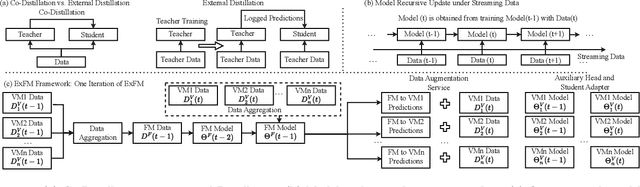
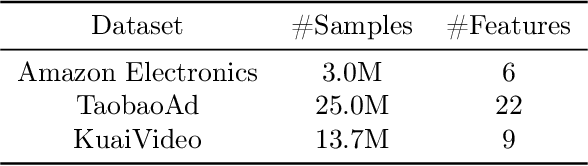
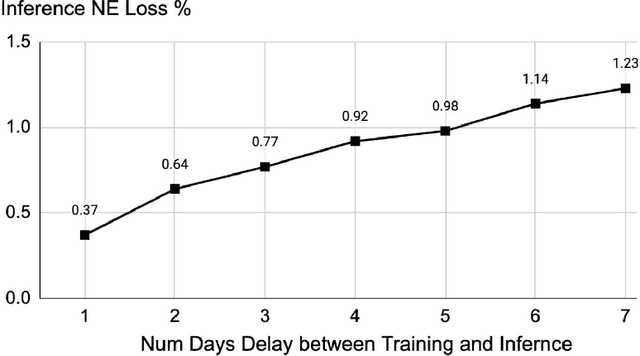
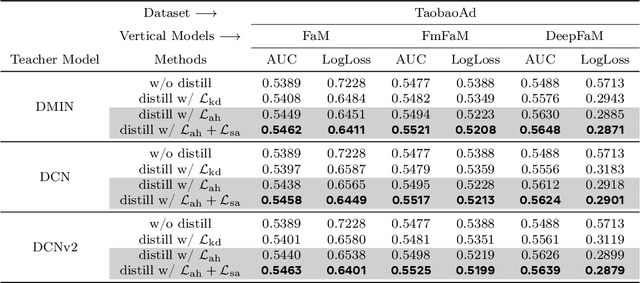
Ads recommendation is a prominent service of online advertising systems and has been actively studied. Recent studies indicate that scaling-up and advanced design of the recommendation model can bring significant performance improvement. However, with a larger model scale, such prior studies have a significantly increasing gap from industry as they often neglect two fundamental challenges in industrial-scale applications. First, training and inference budgets are restricted for the model to be served, exceeding which may incur latency and impair user experience. Second, large-volume data arrive in a streaming mode with data distributions dynamically shifting, as new users/ads join and existing users/ads leave the system. We propose the External Large Foundation Model (ExFM) framework to address the overlooked challenges. Specifically, we develop external distillation and a data augmentation system (DAS) to control the computational cost of training/inference while maintaining high performance. We design the teacher in a way like a foundation model (FM) that can serve multiple students as vertical models (VMs) to amortize its building cost. We propose Auxiliary Head and Student Adapter to mitigate the data distribution gap between FM and VMs caused by the streaming data issue. Comprehensive experiments on internal industrial-scale applications and public datasets demonstrate significant performance gain by ExFM.
Fine-Grained Embedding Dimension Optimization During Training for Recommender Systems
Jan 09, 2024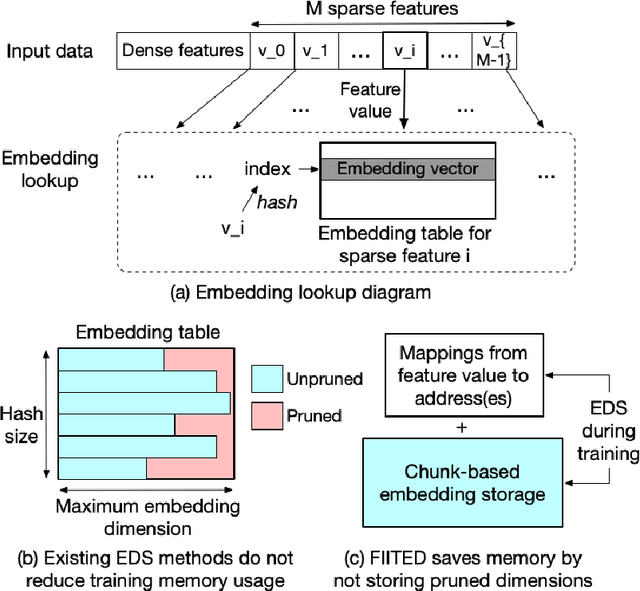


Huge embedding tables in modern Deep Learning Recommender Models (DLRM) require prohibitively large memory during training and inference. Aiming to reduce the memory footprint of training, this paper proposes FIne-grained In-Training Embedding Dimension optimization (FIITED). Given the observation that embedding vectors are not equally important, FIITED adjusts the dimension of each individual embedding vector continuously during training, assigning longer dimensions to more important embeddings while adapting to dynamic changes in data. A novel embedding storage system based on virtually-hashed physically-indexed hash tables is designed to efficiently implement the embedding dimension adjustment and effectively enable memory saving. Experiments on two industry models show that FIITED is able to reduce the size of embeddings by more than 65% while maintaining the trained model's quality, saving significantly more memory than a state-of-the-art in-training embedding pruning method. On public click-through rate prediction datasets, FIITED is able to prune up to 93.75%-99.75% embeddings without significant accuracy loss.
Provably Efficient Generalized Lagrangian Policy Optimization for Safe Multi-Agent Reinforcement Learning
May 31, 2023We examine online safe multi-agent reinforcement learning using constrained Markov games in which agents compete by maximizing their expected total rewards under a constraint on expected total utilities. Our focus is confined to an episodic two-player zero-sum constrained Markov game with independent transition functions that are unknown to agents, adversarial reward functions, and stochastic utility functions. For such a Markov game, we employ an approach based on the occupancy measure to formulate it as an online constrained saddle-point problem with an explicit constraint. We extend the Lagrange multiplier method in constrained optimization to handle the constraint by creating a generalized Lagrangian with minimax decision primal variables and a dual variable. Next, we develop an upper confidence reinforcement learning algorithm to solve this Lagrangian problem while balancing exploration and exploitation. Our algorithm updates the minimax decision primal variables via online mirror descent and the dual variable via projected gradient step and we prove that it enjoys sublinear rate $ O((|X|+|Y|) L \sqrt{T(|A|+|B|)}))$ for both regret and constraint violation after playing $T$ episodes of the game. Here, $L$ is the horizon of each episode, $(|X|,|A|)$ and $(|Y|,|B|)$ are the state/action space sizes of the min-player and the max-player, respectively. To the best of our knowledge, we provide the first provably efficient online safe reinforcement learning algorithm in constrained Markov games.